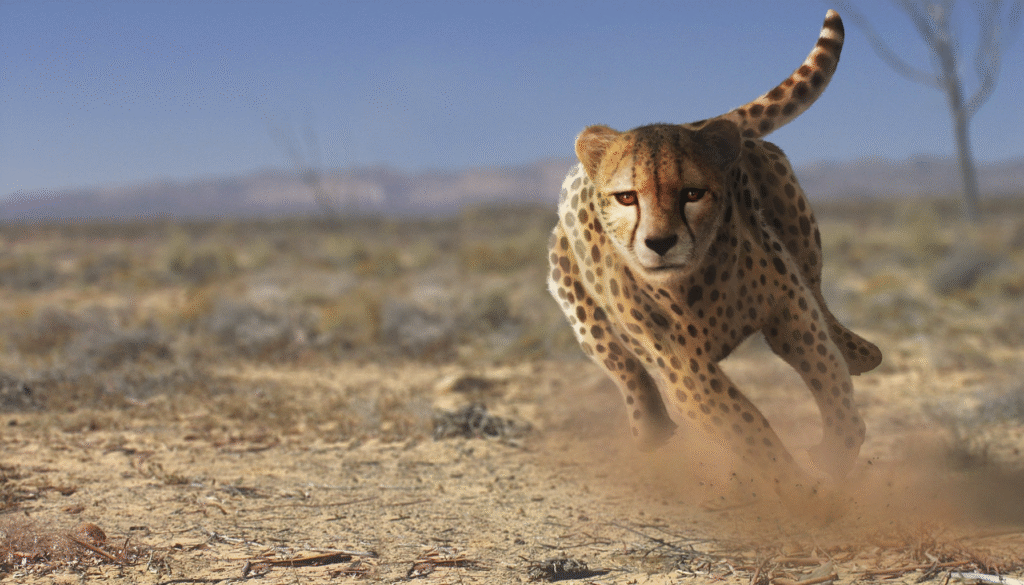

When it comes to speed on land, no animal can outrun the cheetah. With top speeds of up to 70 miles per hour (113 km/h), this feline leaves even the fastest sprinters in the dust.
But what exactly makes the cheetah such a biological speed machine? It’s not just about long legs—it’s a combination of anatomy, physiology, and evolutionary design that makes this big cat a true marvel of nature.
Let’s break down the science behind the speed of the cheetah.
1. A Body Built for Acceleration
Cheetahs don’t just run fast—they accelerate like a sports car. In just 3 seconds, a cheetah can go from 0 to 60 mph (96 km/h), which is faster than many vehicles on the road.
Key features:
- Lightweight frame: Less body weight means less resistance.
- Long, flexible spine: Works like a spring, allowing the cheetah to stretch its body with each stride.
- Small collarbone and floating shoulder blades: Increase stride length and flexibility.
- Narrow waist and deep chest: Support massive lung capacity and allow better breathing during sprints.
2. Specialized Muscles for Speed
Cheetahs have muscles with a high percentage of fast-twitch fibers. These fibers are designed for:
- Explosive bursts of speed
- Rapid contractions
- Short periods of intense activity
Unlike endurance animals, cheetahs are sprinters—they run fast for short bursts, then rest to recover.
3. A Tail That Works Like a Rudder
Ever tried turning while sprinting at full speed? It’s not easy.
Cheetahs have a long, muscular tail that helps them:
- Balance during high-speed chases
- Steer quickly to follow zigzagging prey
- Counterbalance their body when making sharp turns
It’s like having a natural stabilizer that keeps them agile and in control—even at top speed.
4. Claws Made for Traction
Unlike most cats, cheetahs have semi-retractable claws. These claws act more like cleats or running spikes, digging into the ground for:
- Maximum grip
- Improved traction
- Reduced slippage during rapid acceleration
Combine that with hard foot pads, and you get the ultimate high-speed grip.
5. Oversized Nostrils, Lungs, and Heart
Running at extreme speeds requires serious oxygen. Cheetahs have:
- Large nostrils to take in more air
- Enlarged lungs and heart to pump oxygen quickly through the body
- High red blood cell count to carry oxygen efficiently to muscles
This system works together to fuel their sprint, but it also means cheetahs overheat quickly and must rest soon after a chase.
6. A Hunting Style Based on Speed and Precision
Cheetahs rely on:
- Vision over smell: They scan open plains during the day for prey.
- Short-distance chases: Usually no more than 200–300 meters.
- Targeted strikes: They trip prey with a swipe to the legs or bite the throat.
Their speed gives them an edge—but if they miss, they rarely get a second chance.
7. Why Cheetahs Don’t Run All the Time
Despite their speed, cheetahs are vulnerable animals. They:
- Lose prey to larger predators like lions and hyenas
- Must rest up to 30 minutes after a chase to cool down
- Avoid running unless they’re sure of success—it’s too risky otherwise
Speed is their weapon—but it’s also their most limited resource.
Final Thoughts: Speed with Purpose
Cheetahs aren’t just fast for fun. Their entire bodies are engineered for one thing: to catch prey quickly and efficiently.
From their spine to their lungs, claws to tail, every part of a cheetah is tuned for speed, agility, and precision. In the race of evolution, they didn’t just win—they dominated.
The next time you see one in action, remember: you’re not just watching an animal run—you’re witnessing one of the most advanced examples of natural engineering the animal kingdom has ever produced.